Beyond Eye Drops: The Surprising Light-Based Revolution for Your Eyes
That persistent, scratchy sensation—like a stray grain of sand that just won't wash away—is a daily reality for millions suffering from chronic dry eye. This discomfort is more than a minor annoyance; it is often the primary symptom of underlying issues like ocular rosacea or a common side effect of medical procedures like cataract surgery. As we move beyond traditional treatments, a new frontier of light-based therapies is offering a cleaner, more targeted way to restore ocular health.
The "Hidden" Rosacea: Your Dermatologist is Watching Your Eyelids
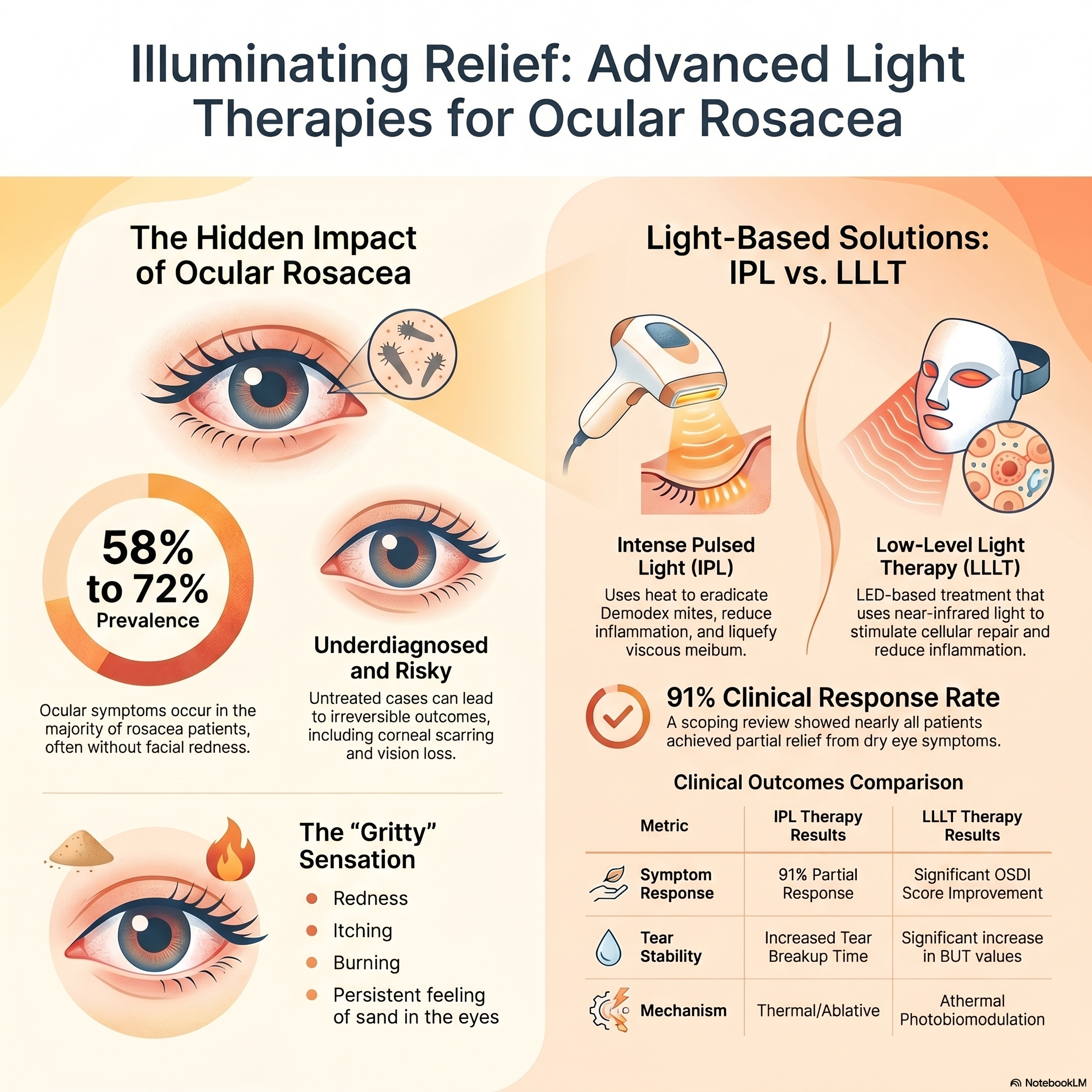
Rosacea is widely known as a skin condition characterized by facial flushing and visible blood vessels, yet its impact on the eyes is staggering. The data tells a staggering story: ocular symptoms are present in an estimated 58% to 72% of rosacea patients. More surprisingly, ocular rosacea can be a "hidden" threat that occurs without any facial skin symptoms at all, making it difficult to diagnose until the inflammation becomes severe.
Because the condition can lead to irreversible vision loss if left untreated, the dermatologist's role in identifying early ocular symptoms is critical. By looking for signs like conjunctival hyperemia and meibomian gland dysfunction, they act as a vital line of defense against the progression of the disease.
"Ocular rosacea is a form of rosacea that affects the eyes and eyelids. This condition can cause symptoms like redness, dryness, itching, burning, and a feeling of grittiness in the eyes, similar to having sand in them."
Antimicrobial Stewardship: Swapping Pills for Photons
For years, the standard response to ocular inflammation was a long-term prescription for oral antibiotics, such as doxycycline. While effective at reducing inflammation, this systemic approach carries the burden of altering the body’s internal microbial balance. The shift toward Intense Pulsed Light (IPL) represents a significant advancement in antimicrobial stewardship. By using targeted photons instead of pills, clinicians can manage ocular symptoms while avoiding the gastrointestinal disruption and systemic side effects associated with chronic antibiotic use. This "cleaner" approach focuses energy exactly where it is needed, preserving the delicate microbiome of the gut while restoring the health of the ocular surface.
The Pre-Surgical "Armor": LLLT Before Cataract Surgery
Cataract surgery is the most common ophthalmic procedure in the world, yet it frequently induces "iatrogenic" (surgery-induced) dry eye that can compromise a patient's visual recovery. Recent clinical breakthroughs suggest we can now "pre-habilitate" the eye using Low-Level Light Therapy (LLLT). This shifts the surgical mindset from merely repairing damage with post-operative drops to actively fortifying tissue before the first incision is made.
The results of this prophylactic "armor" are measurable and profound. In a prospective clinical trial, patients who received LLLT one week before and one week after surgery saw their Ocular Surface Disease Index (OSDI) scores drop from a symptomatic 26.62 to a comfortable 13.36. Furthermore, the therapy prevented the typical postoperative rise in tear osmolarity; the LLLT group maintained a stable 296.11 mOsm/l, while the control group spiked to 306.20 mOsm/l, a level associated with significant ocular surface stress.
"Perioperative LLLT is a safe, well-tolerated, and effective treatment for preventing iatrogenic DED in cataract surgery."
Evicting Microscopic Guests: The Demodex Connection
A fascinating contributor to eye inflammation is the Demodex mite. These microscopic parasites colonize the hair follicles and sebaceous glands of the eyelids, degrading the tear film by increasing the viscosity of meibum (eye oil). This leads to stasis and chronic inflammation. IPL serves as a microscopic eviction notice for these uninvited guests, with clinical reviews showing that 91% of patients achieve a partial response in symptom relief.
The Mechanism of Action:
- Thermal Energy: IPL produces a precise warming effect that melts viscous meibum, facilitating its outflow.
- Parasite Eradication: The heat-induced ablation specifically targets and reduces the density of Demodex mites.
- Vascular Regulation: The therapy aids in the downregulation of pro-inflammatory cytokines and the eradication of abnormal small blood vessels that transport inflammatory mediators to the eyelid margin.
The Power of Photobiomodulation: How it Actually Works
At the heart of this revolution is "photobiomodulation," a process where light penetrates the tissue to be absorbed by the mitochondria—the powerhouses of the cell. This absorption increases the production of Adenosine Triphosphate (ATP), effectively "charging" the cells with the energy required to repair damaged tissue and improve the function of the lacrimal and meibomian glands.
It is important to distinguish between the two primary technologies used in modern clinics:
- Intense Pulsed Light (IPL): Utilizes high-intensity, non-coherent pulsed light to treat inflammation through thermal ablation.
- LED-LLLT: Leverages light-emitting diodes to deliver non-coherent, divergent light. This technology spans both the red (approx. 633nm) and near-infrared (830nm) spectrums. Because LLLT is non-thermal and lower intensity, it is inherently safe and can be used in a hands-free manner to treat the entire periorbital area.
Unlike artificial tears, which merely add temporary moisture to the surface, photobiomodulation fixes the underlying biological machinery of the eye by empowering the body's own regenerative pathways.
Conclusion: A Future in a New Light
Light therapy is rapidly moving from a novel alternative to a standard of care in ocular health. By reducing our reliance on chronic eye drops and systemic antibiotics, we are entering an era of non-invasive medicine that treats the root cause of discomfort rather than just the symptoms.
As these technologies become more integrated into routine perioperative care and dermatology, we must ask: how much more of our healthcare can be improved by simply harnessing the right wavelengths of light? Being proactive about ocular health today means looking beyond the bottle and seeing your vision in a whole new light.